I have received no less than 4 phone calls from the Canadian National Student Loans Service Centre in the past 3 days informing me that I have to begin paying back my government student loan by the end of March. I'm not talking about pre-recorded messages - I mean actual people calling me to remind me that I need to start paying1. I'm also paying back a bank loan I took out to pay for my ludicrously expensive undergraduate degree at Dalhousie.
It's nice that postdocs make considerably more money than graduate students, but I'm not really seeing any of that extra dough. Did I mention that the Washington, D.C. area is ridiculously expensive to live in? I don't know anyone who pays less than $1000 USD per month on a single bedroom apartment, and that's assuming that you live a ways out of the city proper. By the time you pay your rent, bills, and debts each month, there's very little money left.
Some people have told me that they find that groceries are much cheaper in the States, but I don't see it. About the only thing that's much more economical here is liquor, and now I think I know why...
P.S. This post is way more morose than I intended it to be. I'm tired and feeling broke. Sorry!
1Incidentally, I called the NSLSC when I first began my postdoc in order to set up a payment plan and they told me that I wasn't allowed to. I had to wait for the 6 month 'grace' period to be over. I still have to pay the capitilized interest on those 6 months, however. Thanks for nothing.
|
|
|---|
Wednesday, February 24, 2010

Monday, February 22, 2010
Bad Biology: District 9...
Don't worry, I'm not breaking with my plan of ranting on Mondays. I assure you that this post has all of the trappings of a rant. However, the post does contain 'spoilars' so if you haven't seen District 9, you may want to pass on this one.
I've been a pretty big movie buff for years now, and yet I haven't been watching a lot films since moving to the United States. One reason for this is simply time constraints, but a second is perhaps more practical: I have no idea where to rent movies anywhere near where I live. Thus, I've decided to remedy this situation by getting a Netflix account. That's besides the point though.
I have been watching some movies - basically anything interesting that I've found on blu-ray for cheap. One film that I picked up a few weeks ago, based on the recommendations of various people and web sites, was District 9. I know I'm late to the party, but I had to discuss this one.
Now, I could talk about the rather preposterous notion that various, powerful world governments would let South Africa commit apartheid against the most significant discovery in the history of human civilization1. However, as you've probably figured out from the title of the post, that's not what bothered me the most. Rather, it's the simple fact that there is SO much wrong with the idea that some alien sludge could transform a human into one of said aliens that I don't even know where to begin.
Ok, first off, based on casual inspection of said aliens, we have to assume that their biology is fairly significantly different from our own:
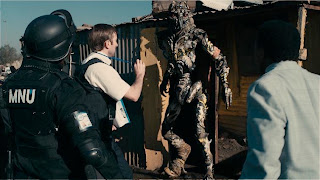 The aliens kinda look like crustaceans. Aside from the lack of inventive exobiology, I doubt that their cellular biology is near-identical to ours. Image cred here.
In order for such a mutagenic cocktail to work, it needs to supply the cellular machinery required to effect the transformation: people don't possess genes 'for' turning into aliens. Nor - considering a more basic level - do we possess genes for making chitin exoskeletons, for instance. Even assuming that the cocktail contains all such proteins (as well as an appropriate vector for delivery, and the proper regulatory machinery to activate them at the appropriate times, etc.) there's still the fundamental problem that such molecules would have to be able to 'work' with the molecules that humans already do possess.
This is non-trivial. I did a Ph.D. in speciation biology and it's easy to observe that proteins derived from different species that share a common ancestor only ~2.5 million years ago cannot properly work together. And this results only from passive evolutionary forces. How in the hell are we supposed to believe that species that evolved independently on different planets have compatible molecular machinery??? Do they even use DNA? How about proteins containing the exact same 20 amino acids that terrestrial life does?
Giving the sci-fi nerd the benefit of the doubt, let's assume that the aliens studied humans and developed this cocktail with their sophisticated technology. Why would they ALSO use it to power their ships?!?!? That's like a motor oil company telling their chemists that they want the Valvoline to ALSO cure cancer. WTF?
I have to cut District 9 a bit of slack simply because it never claimed to be a 'hard' sci-fi story - as alluded to above, it's not like the rest of the film's elements were believable. Regardless, as I've brought up before, I think that the popular conception of aliens is somewhat marred by our inability to contemplate the implications of species adapted to worlds that are likely to be different from our own. There's no guarantee that such aliens would be bipedal, or be able to breathe our atmosphere, or be able to eat our food - cripes, we get sick eating species that yet other species have no problem consuming.
I'm not exactly sure what I'm looking for when it comes to sci-fi aliens, but I am certain that I haven't found it yet. Aliens are either so familiar as to be completely boring (such as the races in Star Trek that didn't even have weird stuff glued to their foreheads to distinguish them from humans), or so different as to be completely terrifying. What about the non-familiar, yet not hostile? Oh right, because that would be awkward, uncomfortable, and slightly frightening, which is pretty much exactly what I'd imagine any plausible alien encounter would be like. District 9, on the other hand, is mostly devoid of such feelings, and rather shares some parallels with 80s movies and old SNL skits: humanity's immediate reaction to the discovery that we're not alone in the cosmos is annoyance.
1Now don't get me wrong, I am familiar with the concept of a literary device, and it's evident that the entire premise of the alien presence is meant to convey a more fundamental message. However, such devices work best when they're set within the context of a believable narrative. If the story is so jarringly ridiculous that we cannot suspend our disbelief enough to empathize with the characters, the device fails.
I've been a pretty big movie buff for years now, and yet I haven't been watching a lot films since moving to the United States. One reason for this is simply time constraints, but a second is perhaps more practical: I have no idea where to rent movies anywhere near where I live. Thus, I've decided to remedy this situation by getting a Netflix account. That's besides the point though.
I have been watching some movies - basically anything interesting that I've found on blu-ray for cheap. One film that I picked up a few weeks ago, based on the recommendations of various people and web sites, was District 9. I know I'm late to the party, but I had to discuss this one.
Now, I could talk about the rather preposterous notion that various, powerful world governments would let South Africa commit apartheid against the most significant discovery in the history of human civilization1. However, as you've probably figured out from the title of the post, that's not what bothered me the most. Rather, it's the simple fact that there is SO much wrong with the idea that some alien sludge could transform a human into one of said aliens that I don't even know where to begin.
Ok, first off, based on casual inspection of said aliens, we have to assume that their biology is fairly significantly different from our own:
 The aliens kinda look like crustaceans. Aside from the lack of inventive exobiology, I doubt that their cellular biology is near-identical to ours. Image cred here.
In order for such a mutagenic cocktail to work, it needs to supply the cellular machinery required to effect the transformation: people don't possess genes 'for' turning into aliens. Nor - considering a more basic level - do we possess genes for making chitin exoskeletons, for instance. Even assuming that the cocktail contains all such proteins (as well as an appropriate vector for delivery, and the proper regulatory machinery to activate them at the appropriate times, etc.) there's still the fundamental problem that such molecules would have to be able to 'work' with the molecules that humans already do possess.
This is non-trivial. I did a Ph.D. in speciation biology and it's easy to observe that proteins derived from different species that share a common ancestor only ~2.5 million years ago cannot properly work together. And this results only from passive evolutionary forces. How in the hell are we supposed to believe that species that evolved independently on different planets have compatible molecular machinery??? Do they even use DNA? How about proteins containing the exact same 20 amino acids that terrestrial life does?
Giving the sci-fi nerd the benefit of the doubt, let's assume that the aliens studied humans and developed this cocktail with their sophisticated technology. Why would they ALSO use it to power their ships?!?!? That's like a motor oil company telling their chemists that they want the Valvoline to ALSO cure cancer. WTF?
I have to cut District 9 a bit of slack simply because it never claimed to be a 'hard' sci-fi story - as alluded to above, it's not like the rest of the film's elements were believable. Regardless, as I've brought up before, I think that the popular conception of aliens is somewhat marred by our inability to contemplate the implications of species adapted to worlds that are likely to be different from our own. There's no guarantee that such aliens would be bipedal, or be able to breathe our atmosphere, or be able to eat our food - cripes, we get sick eating species that yet other species have no problem consuming.
I'm not exactly sure what I'm looking for when it comes to sci-fi aliens, but I am certain that I haven't found it yet. Aliens are either so familiar as to be completely boring (such as the races in Star Trek that didn't even have weird stuff glued to their foreheads to distinguish them from humans), or so different as to be completely terrifying. What about the non-familiar, yet not hostile? Oh right, because that would be awkward, uncomfortable, and slightly frightening, which is pretty much exactly what I'd imagine any plausible alien encounter would be like. District 9, on the other hand, is mostly devoid of such feelings, and rather shares some parallels with 80s movies and old SNL skits: humanity's immediate reaction to the discovery that we're not alone in the cosmos is annoyance.
1Now don't get me wrong, I am familiar with the concept of a literary device, and it's evident that the entire premise of the alien presence is meant to convey a more fundamental message. However, such devices work best when they're set within the context of a believable narrative. If the story is so jarringly ridiculous that we cannot suspend our disbelief enough to empathize with the characters, the device fails.
Thursday, February 18, 2010
Book Club: Evidence as to Man's Place in Nature...
I've been meaning to read Thomas Henry Huxley's Evidence as To Man's Place in Nature (EMPN; 1863) for a long time now. I saw an online lecture given by Sean B. Carroll, the famous evo-devo guru, who said that the book was both still relevant and much easier to read than say, The Origin of Species. I agree.
The history of EMPN is quite interesting. Huxley (a.k.a. 'Darwin's Bulldog') was a firm evolutionist and supporter of Darwin's theory from its inception and, following the publication of Darwin's book (1859), had discussed the idea of publishing his own book about the subject with his friends. Even those that supported the idea of evolution cautioned him that given the controversial nature of the subject, publishing such a book could sink his career.
Huxley specifically wanted to write a book about the relationship between humans and apes, and became embroiled in a controversy while researching the material for such an undertaking. Richard Owen, a very famous 18th century British biologist/paleontologist (the man who coined the term 'dinosaur'), published a paper in 1860 arguing that humans could be considered apart from the apes because only their brains possessed a posterior lobe, a posterior cornu, and the hippocampus minor. Curiously however, previous anatomical treatises had indicated that these structures were shared among all apes.
Huxley confronted Owen about his erroneous assertions first privately, then publicly, even going so far as to contact other experts in order to get them to plead with Owen to change his tune. All the while, Owen refused to admit that he was wrong, despite numerous publications and mounds of evidence indicating that these structures were not unique to humans. In the end Huxley ended up writing and publishing EMPN as a series of essays, spured primarily by a desire to prove Owen wrong. By the time of the book's publication, the evidence against Owen was overwhelming, and people began questioning why Britain's premier biologist seemed to be fabricating data in order to undermine the hypothesis that humans were related to apes. Huxley's book was so carefully written and detailed that it came off as eminently reasonable as compared to Owen's controversy, and thus it was both well-respected and extremely popular.
The book itself is divided into 3 parts, the first of which is a long and quite tedious summary of everything we know about the history, anatomy, and behavior of apes. While dry and technical, it's still quite interesting to learn about how Europeans first encountered their nearest relatives, and the lengths that Victorian-era folk had to go to to study them. In short, people during Huxley's time knew very little about ape behavior and life-history, and only had a limited number of skeletons available for comparative anatomy.
The second part is much more interesting. Huxley begins by arguing that a proper taxonomy (classification) of living organisms is based upon similarity among species. Members of a genus, for example, should be more similar to one another than any is to members of a separate genus1. After establishing this, Huxley goes on to point out that no one argues that animal species cannot be classified into a Linnean taxonomy based on such criteria. Therefore, he points out, if it can be 'shewn' that humans are more similar to apes than any other species AND that humans possess no anatomical features that are so radically different from those of apes that they obviously call for Homo sapiens to be classified outside of the animal kingdom, then logically, humans are apes. It's at this point that Huxley goes into a long anatomical treatise, specifically intended to shoot down the claims of people like Richard Owen, or that humans possess unique structures that apes do not (note here that there's no doubt that there are differences, among great apes, but these are quantitative, not qualitative).
Finally, after establishing that humans should be classified as primates, Huxley broaches the obvious, post-Darwinian notion that humans probably evolved from ape-like ancestors. This section is particularly interesting, because it played a large part in making the author's career. Though he spends a decent number of pages on the subject of human evolution, Huxley never speculates beyond what the extremely limited (at the time) evidence suggests. He's incredibly cautious, throwing out caveats when appropriate, which solidified his reputation as a 'man of science'. In fact, even fellow scientists who strongly disagreed with Huxley's views respected him, because his arguments were sound and logical, rather than pleas to passion.
All in all, EMPN is a short, eminently quotable book that, despite being 'Victorianly wordy', is still completely readable. I'm trying to get involved in teaching a graduate-level course in evolutionary biology (specifically targeted towards human evolution) , and if I don't assign the book as required reading, I'd certainly draw a lot of good information from it.
1An interesting aside here is that modern anatomical taxonomy recognizes that a blanket statement such as 'is more similar to' can often be misleading, especially in very complex, speciose groups such as insects. Modern taxonomy (or at least one branch of it) focuses on shared derived characteristics, or 'synapomorphies'. For instance, all apes lost the tail that their ancestors possessed. Shared inherited characters are passive, whereas newly derived characters are far more informative.
Monday, February 15, 2010
Monday Rant: Methods...
A couple of years ago, I blogged about the problem with the materials and methods sections of scientific publications - then specifically in the context of microarrays. However, I feel the need to extend this rant far beyond the bounds of any particular technique/discipline. My rant today can be summed up in a single sentence: If I cannot reproduce the work that you're presenting in this paper, it's not science.
For all of the non-scientists out there, here's how a scientific publication (typically) works. Essentially, every time you want to write up the results of your work, you prepare it in a manuscript with five basic sections: An abstract summarizing the entire manuscript, an introduction giving background and context, and stating the objectives of the study, a methods sections explaining how things were done, a section passively detailing the results of the work, and a final discussion section interpreting the results in the context of the introduction (what have we learned?).
Modern publications have become ridiculously bloated, partially because the level of technical detail in any given field is ever-increasing, but also because in fields like mine - speciation genomics - any given study is going to generate a huge amount of data to present. If you disagree with the 'bloated' comment, then go back and look at Watson and Crick's 1 page Nobel Prize winning paper from 1953. Publishing is expensive, and Journals are always looking for ways to keep the published page-count to a minimum. Thus we end up in a situation where many a methods section ends up as a supplementary section that's online available online, where, frankly, it's likely that it was never properly peer-reviewed.
Even considering the fact that many scientific journals are moving online (i.e., that is no longer publishing expensive print versions), it's still questionable how much of the original data submitted for any given publication actually gets reviewed. Many genome-scale datasets are immense, and 20+ megabyte Excel spreadsheets are rather daunting. Thus the responsibility for making sure that your work is adequately documented and described really does ultimately rest in your own hands.
And this is why it's so unfortunate that I so frequently hear people complain about the quality of methods sections. It's absolutely typical to see people say things like "RNA was extracted according to standard protocols," or "X was performed as per Smith et al. 2002." That last one is particularly annoying when you go back to the paper they reference and find that it says that the technique was performed according to 'standard' protocols.
I know it's annoying and that everyone's busy, but if I had things my way I'd like it if everything was described in detail in every publication. I'm not opposed to having individual protocols made available as supplementary material online, but I should be able to understand the entirety of what was done by reading a paper's methods section, without having to refer back to another slew of texts or attempt to interpret what 'standard' methods were used. This is such a huge problem that I'm surprised that it's not being discussed more among the scientific community - perhaps I'm just out of the loop?
Wednesday, February 10, 2010
Snowmaggedon and the Fever of Cabins...
I'm really beginning to know what 'cabin fever' is. I spent almost all of Friday, Saturday, and Sunday indoors because of the heavy snowfall the D.C. region's received over the weekend. Unfortunately, another blizzard started up last night, shutting down the entire bus and above ground Metro rail system meaning that I couldn't even make it into the lab today if I wanted to (which I did want to).

Snow's a really big deal here. The city doesn't typically get much of it, and thus unlike where I grew up in Eastern Canada, they're not really prepared for it. Main roads aren't very well plowed and side streets are lucky if they get plowed at all. Sidewalks, for the most part, aren't cleared at all, and thus for several days after the snowfall, it's impossible to go anywhere by foot.

To give you an idea of how much people panicked when they heard about this second wave of snow, here's a photo I snapped yesterday of the entire meat aisle in my local Safeway. Pretty crazy hunh?
The snow is creating a huge problem for us. Our lab orders fresh fly food weekly from Tennessee, but the NIH has been closed since Friday last week and since roads and airports are going to be closed for a bit, it's highly unlikely that we're going to be able to get our order in this week. That means emergency transfers only and halted experiments: never a good thing.
I realize that only a crazy postdoc complains about not being able to go into work, but I'm acutely aware that I have a ton of work to do. Until I solve the difficulties I've been having with my flies, I'm not going to be able to relax and get into a 'work grove'. Also, it's now been a whole week since I've been to the gym, and I'm getting soft.
P.S. By commenter demand, I've decided to order that crazy alien conspiracy book from Amazon next time that I make a purchase. I can't even claim that I'll read it with an 'open mind' while keeping a straight face: let's face it, there's a 99.999999999999999% that I'm going to take it apart chapter-by-chapter on the blog. It's gonna be fun!
Monday, February 8, 2010
Priorities...
Last month was a tough one, as should clearly have been evident from my low blogging output. Our entire lab was burning the midnight oil on a big collaborative data analysis project, and the shear amount of time I was spending on work was basically making my brain mush. Thus my normal diet of perusing geeky websites and blogs has suffered, along with my reading of science-related books. Most of my free time has instead been directed towards pursuits of a more escapism bent (e.g., escaping into the fuzzy haze of alcohol, or escape into the wonderful world of blasting evil aliens1).
1As a good friend of mine says to me at least once a week: "I can't believe you're a doctor."
P.S. Also, like TheBrummell, I've unfortunately been forced to turn on comment word verification due to the mysterious rise in the amount of crazy comment spam.
These all feed into one another, you know. Reading science books gives me ideas for blog posts, as does reading and commenting on other blogs. Sure, I could talk about some of the awful fantasy novels I've read in the past few weeks, but who'd want to hear about that?
Actually, given my normal blog readership, I doubt that fantasy would be too low brow (don't take offense, I'm the one reading the books!). Also, given that it's technically Monday, allow me to spew forth a micro-rant. Is there anyone who actually likes to read fantasy novels in which the characters are constantly saved from impossible situations via crappy Deus Ex Machina tropes? Have you ever reached the end of a book and realized that the main characters didn't actually accomplish anything, but were rather miraculously saved from every situation by [INSERT DRAGON/MAGIC/LEGENDARY TOILET SEAT/NATURAL DISASTER/ETC. HERE]? Also, doesn't it bother anyone that the Evil Dark Lord™ who managed to conquer and subjugate all but a plucky young band of mismatched heroes + Love Interest™, is otherwise completely incapable of doing anything right?
Ok, I'm done. I promised myself I wouldn't read any of those books anymore, but I've been trying to save on expenditures this month and have been going back to the 'To read' pile - most of which is made up of fantasy novels I'd purchased years ago.
Anyways... sorry, back to the topic. So yeah, gotta get back into reality and immerse myself in science reading again. In order to facilitate this, I finally picked up a copy of Thomas Henry Huxley's Evidence as to Man's Place in Nature (1863). This is a book I've been wanting to read for a while, and given that it's quite brief, I hope to be able to have a book club post about it soon.
Also, I've mostly run out of aliens to shoot.
1As a good friend of mine says to me at least once a week: "I can't believe you're a doctor."
P.S. Also, like TheBrummell, I've unfortunately been forced to turn on comment word verification due to the mysterious rise in the amount of crazy comment spam.
Pure Insanity...
Having survived the 'snowpocalypse', I emerged from my apartment yesterday with the intent of making my way to the Barnes and Noble down the street. The going was tough, but I eventually made it, only to be greeted by the craziest book I've ever seen! Please, please read the synopsis if it's the only thing you do today:
Grey Aliens and the Harvesting of Souls: The Conspiracy to Genetically Tamper with Humanity
Nigel Kerner, Bear & Company, 2010
In 1997 Nigel Kerner first introduced the notion of aliens known as Greys coming to Earth, explaining that Greys are sophisticated biological robots created by an extraterrestrial civilization they have long since outlived. In this new book Kerner reveals that the Greys are seeking to master death by obtaining something humans possess that they do not: souls. Through the manipulation of human DNA, these aliens hope to create their own souls and, thereby, escape the entropic grip of the material universe in favor of the timeless realm of spirit.
Kerner explains that genetic manipulation by the Greys has occurred since biblical times and has led to numerous negative qualities that plague humanity, such as violence, greed, and maliciousness. Racism, he contends, was developed by the aliens to prevent their genetic experiments from being compromised by breeding with others outside their influence. Examining historical records, Kerner shows that Jesus, who represented an uncorrupted genetic line, warned his disciples about the threat posed by these alien interlopers, while Hitler, a pure product of this alien intelligence, waged genocide in an attempt to rid Earth of all those untouched by this genetic tampering. Despite the powerful grip the Greys have on humanity, Kerner says that all hope is not lost. Greys exist wholly in the material world, so if we follow the spiritual laws of reincarnation and karma, aiming for enlightenment and rising above the material--a state the Greys are unable to reach--we can free ourselves from their grasp.
THIS is why I hate conspiracy theories...
Subscribe to:
Posts (Atom)