This was a pretty rough summer for me on many fronts: some personal, some professional. The latter had a lot to do with my effort to juggle a fairly time-consuming research project, while trying to manage an ever-shifting 'side-project' that lacked a clear objective and continued to metamorphose as the weeks went by. Sadly, I ended up writing 25 pages of a manuscript that will not see the light of publication in its current form1.
I worked really hard on that side-project, so much so that I essentially abandoned my 'main' research for ~2 months. That's really not a lot of wasted time in the grand scheme of things. I suppose I've wasted more time in the past, but that was 4 years ago now and I've become quite used to being extremely organized about effort.
This brings us to the title of my post - I feel like I experienced a minor burn-out. I can tell that my general love of science, which is to say the amount of time I spend actively immersing myself in scientific culture outside of the work I'm required to do, dropped a bit during this season. I stopped reading science books, stopped following science blogs, stopped talking about science outside the lab, etc. As I'm sure I've said many times on the blog, this isn't very conducive to being in the sciences: research is a difficult job to pursue if you're not regularly thinking about possible ways to expand your work. It's also a heck of a lot of work to not enjoy, if you catch my drift.
I can feel some of my enthusiasm returning though. This is partially seasonal: Autumn is by far my favorite time of the year, and I'm looking forward to such niceties as colorful leaves, pumpkin pies, and not sweating to death every single day (the ice-water that flows through my Canadian veins isn't built for the heat here). However, the major part of my changing attitude is probably getting back to my main project. This is what I came here to do, and what I what I wrote-up for my funding proposal: It's what I actually wanted to work on. Oh, it's also helping that I'm reading science books again - Thomas Kuhn's The Structure of Scientific Revolutions will be a book club post soon!
Hopefully I'll come around soon. Hey, if everything becomes rosy again and I get a few hours of free time, maybe I'll continue blogging about that crazy alien book again. Who knows?
1All is not lost, however, as I learned a lot of useful information/techniques in preparing said manuscript, and large sections of it will be cannibalized for a forthcoming study.
|
|
|---|
Sunday, August 29, 2010

Thursday, August 26, 2010
Impact in the Laundry


Some tips for doing your laundry with sustainability in mind are to firstly wash them only if they really need cleaning. If you wear a separate layer underneath your garment, the top layer will likely be fine for another wear. Less washing means your garments will actually last longer, save water and also save energy.
When it comes to washing, your choice of laundry detergent will also have an impact. Choose a detergent with plant and mineral derived ingredients. Here at Rant we currently use the New Zealand brand Eco Store for our water efficient front loader, though previously used the Earth Choice brand when we had a top loader. We noticed that Planet Ark now have a laundry product too (Aware), though we have not tried this one, and are sure there are many other great ones on the market too.
If you use a heavy duty detergent that has stain removers, optical brighteners, etc. it is going strip the colour out of your clothes and wear them out quicker. It is not needed on garments unless you have grease and dirt on your clothes. Save these detergents for 'kids sports clothes' not your bamboo jersey and silks. Always use cold water as warm and hot water can shrink natural fibres. The only exception to this rule is when washing wools, which need warm water.
Lastly, how you dry your garments also has an impact on their lifetime and the environment. While it is best to dry them on your clothes line (simply shake out your garment and place directly on a suitable hanger) we do strongly recommend to keep your Rant garments out of direct sun (as this will bleach them). If you do need to use a dryer there are very efficient ones out there that use a heat pump. Here at Rant your prewashed garments will either be hung in the shade or we use a 6 star energy efficient dryer.
Any questions ? Send us an email via the contact page on the Rant website and we hope this has shed some light on reducing your impact in the laundry !
Wednesday, August 25, 2010
The Bleeding Edge...
Prior to my postdoc, I've never done research using 'bleeding edge' technology, which the Wikipedia defined as:
While every project requires some degree of methods development, pretty much everything I've done before used well established protocols and procedures. This is no longer the case.
One of the techniques of which I've been making extensive use is RNA-seq, or short-read sequencing of RNA. The gist of this technique is that you extract RNA from a cell fragment it into small pieces and then convert it to DNA. You then generate millions of short reads (~75-100 bp nowadays) off of this DNA using flow-cell based sequencers (see the link I provided to RNA-seq for details) and map (align) these reads to the genome of the organism with which you're working. The read 'density' (or number of reads mapping to any given region of the genome) is correlated with abundance of the RNA in the original pool, and thus you get a digital read out of the abundance of all of the transcripts in the cell. In principle this technology has many benefits over traditional methods of transcriptome profiling, such as allowing isoform detection, and is widely expected to eventually replace microarrays.
While this is all fine and dandy, the more I use RNA-seq, the more concerned I become about it. A lot of people have jumped on this bandwagon and there hasn't been a lot of work done to investigate potential biases and caveats associated with the instruments required to generate these data. Here's a couple of examples: The relationship between number of reads mapping to a given gene/exon and its expression level only holds if reads are randomly distributed with respect to what's being sequenced - there shouldn't be sequences that are preferentially sequenced or underrepresented. Unfortunately, this does seem to be the case - either during fragmentation or sequencing library preparation, biases are introduced making certain sequences more or less common than would be expected by chance. It appears that this does not have a large effect on expression estimates of highly expressed genes, but genes with low expression, or short coding sequences show more variability than they should.
A much more significant problem is that many papers seem to have assumed that RNA-seq is somehow beyond the need to 'normalize' data (that is control for systematic biases). It isn't (see Srivastava and Chen 2010, for example). A slew of recent papers have shown that there are biases associated with short read data, especially when the cells/tissues/organisms being compared have radically different expression profiles. Normalization is required, but rarely applied. Oh, and I haven't even gotten into the serious problem of lack of replicates in many of these studies.
These are just some of the issues RNA-seq users face. Now, you may be asking yourself why I'm telling you this; I assure you it's not a rant. My bigger point is this: Our lab has been spending an inordinate amount of time investigating the very real biases that these issues may be creating in our data. However, at the same time, other groups are using the tools available, limited as some may be, and publishing work under the assumption that such biases are not 'show stoppers'. Whether they are or not is difficult to say at this point, but we're pretty much at the mercy of labs with a much better grasp of statistics to come up with solutions as to how to properly normalize and handle these data.
To what extent is it reasonable to use the tools available and assume that they're 'good enough'? Science is always progressing/refining its products, so is it okay to use particular methods, even if you suspect that they're producing uncontrolled biases? I think that the vast majority of what's being done in the field is quality (as far as we know what quality is) but the use of such new technology is somewhat worrisome.
Thoughts?
Bleeding edge technology refers to technology that is so new that the user is required to risk unreliability, and possibly greater expense, in order to use it.
While every project requires some degree of methods development, pretty much everything I've done before used well established protocols and procedures. This is no longer the case.
One of the techniques of which I've been making extensive use is RNA-seq, or short-read sequencing of RNA. The gist of this technique is that you extract RNA from a cell fragment it into small pieces and then convert it to DNA. You then generate millions of short reads (~75-100 bp nowadays) off of this DNA using flow-cell based sequencers (see the link I provided to RNA-seq for details) and map (align) these reads to the genome of the organism with which you're working. The read 'density' (or number of reads mapping to any given region of the genome) is correlated with abundance of the RNA in the original pool, and thus you get a digital read out of the abundance of all of the transcripts in the cell. In principle this technology has many benefits over traditional methods of transcriptome profiling, such as allowing isoform detection, and is widely expected to eventually replace microarrays.
While this is all fine and dandy, the more I use RNA-seq, the more concerned I become about it. A lot of people have jumped on this bandwagon and there hasn't been a lot of work done to investigate potential biases and caveats associated with the instruments required to generate these data. Here's a couple of examples: The relationship between number of reads mapping to a given gene/exon and its expression level only holds if reads are randomly distributed with respect to what's being sequenced - there shouldn't be sequences that are preferentially sequenced or underrepresented. Unfortunately, this does seem to be the case - either during fragmentation or sequencing library preparation, biases are introduced making certain sequences more or less common than would be expected by chance. It appears that this does not have a large effect on expression estimates of highly expressed genes, but genes with low expression, or short coding sequences show more variability than they should.
A much more significant problem is that many papers seem to have assumed that RNA-seq is somehow beyond the need to 'normalize' data (that is control for systematic biases). It isn't (see Srivastava and Chen 2010, for example). A slew of recent papers have shown that there are biases associated with short read data, especially when the cells/tissues/organisms being compared have radically different expression profiles. Normalization is required, but rarely applied. Oh, and I haven't even gotten into the serious problem of lack of replicates in many of these studies.
These are just some of the issues RNA-seq users face. Now, you may be asking yourself why I'm telling you this; I assure you it's not a rant. My bigger point is this: Our lab has been spending an inordinate amount of time investigating the very real biases that these issues may be creating in our data. However, at the same time, other groups are using the tools available, limited as some may be, and publishing work under the assumption that such biases are not 'show stoppers'. Whether they are or not is difficult to say at this point, but we're pretty much at the mercy of labs with a much better grasp of statistics to come up with solutions as to how to properly normalize and handle these data.
To what extent is it reasonable to use the tools available and assume that they're 'good enough'? Science is always progressing/refining its products, so is it okay to use particular methods, even if you suspect that they're producing uncontrolled biases? I think that the vast majority of what's being done in the field is quality (as far as we know what quality is) but the use of such new technology is somewhat worrisome.
Thoughts?
Sunday, August 22, 2010
'Field' Story from Spring Breeze
The Field story for the Spring Breeze collection has now been delivered to all our stockists.
What we thought to do is highlight some of the design details and fit on a couple of the key styles for this story.
The Field skirt and Field pant both feature an innovative buttoning detail which allows you to either have a more bold look with the feature panel buttoning towards the front, or button the panel with the stunning embroidery behind for a more subtle look.
See this illustrated below for the Field skirt...


The Field pant, in addition to the clever buttoning detail, has been designed with a low crotch shape for comfort. Along with the shaped waistband this style should sit comfortably on your hips and be perfect for when the weather starts warming up, typical of the Rant layered look.
Pictures showing the Field pant sketch and how it is worn differently by changing the buttoning are below...


Enjoy your Rant garments !
Paying the Piper...
It's an interesting fact that when you're young, you really tend to think about the consequences of all of the loans you end up taking out in order to pay for post-secondary education (at least if you're growing up in North America, that is). Once the student loans get up into the 5 digits, what's another ten grand here or there? This is further compounded because the loans sit completely in the back of your mind for years and years, providing much needed cash seemingly without consequence.
Unfortunately school ends, and everyone must eventually 'pay the piper'.
 In the folk legend, the Pied Piper of Hamelin takes care of the city's rat problem by playing his magic flute and causing the vermin to jump into the nearby river. When the city refuses to pay him for his deed, he retaliates by using his magic flute to ensorcel the city's children and march them out of town, after which they are never seen again. Thus the origin of the idiom, 'Time to pay the Piper'. Image cred.
All told, I'm roughly $25,000 in debt - not that bad if you consider that I spent 10 years in University. Now that I'm a postdoc, I've begun having to pay it back - as expected, I should add. This is the point where one realizes that say, $1,000 is actually a lot of money. Put into more concrete terms, if I wanted to pay back $1000 in one year, that would be ~$83.34 per month, a not insubstantial amount of dough, when one considers that that's essentially an extra cell phone bill.
I know what you're thinking: This is all obvious. Unfortunately, I don't really think that it is, at least to many people. Paying ~$300/month for 5 years is fairly typical of someone coming out of university in North America. That's a pretty big chunk of change when you're living on a postdoc's salary. Many Europeans, for example, come out of post-secondary education without any tuition-based debt, which is pretty amazing.
As scientists, not only do we experience arrested development by spending a decade (or more in school), but we're further cramped by living in relative squalor for the first few years in the work-force (assuming that most people consider a postdoc being actually in the work-force...)! Oh well, them's the breaks, I guess. Someday I'll have the dough to do all of those wonderful things I've always wanted to do. Bah, who am I kidding?!?
Tuesday, August 17, 2010
Belated Monday Rant: American Banking...
Because some people may be unfamiliar with the rants on my blog, I'll say at the outset that I'm quite enjoying my experience living in America. Just because I take issue with a few differences between the States and Canada (e.g., public transit here) doesn't mean I'm a hater. Don't get any crazy ideas. That being said, I'm somewhat annoyed by the American banking system. On the outside banks appear to be very similar to the way they work in Canada; however, when you have to deal with tellers face-to-face, you begin to notice differences... aggravating differences.
I use two banks and both of them require that I fill out paper forms in order to carry out any transactions. Wanna make a deposit? Fill out a form helpfully titled 'Out of State Banking Form' (despite my not banking out of state) wherein you're required to itemize all deposits, write out your name and address, include your account number, etc. WTF? Isn't this what computers are for??? Here's how it works in Canada:
TELLER: How may I help you?
ME: I'd like to deposit [INSERT CHECKS/MONEY ORDERS/CASH/FOREIGN CURRENCY].
TELLER: Please swipe your client card and key in your PIN.
ME: *does as requested* *hands teller deposits*
TELLER: Is there anything else I can help you with?
Am I crazy for not having memorized my bank account numbers? I have a client card, why should I carry around more stuff? I got a card from one of my banks that just has my bank account # printed on it for cripes' sake! Whether you want to deposit or withdraw funds, it's all about filling out paper forms here.
Also, it's incredibly difficult to handle foreign currency in the States. Some banks won't deal with it at all, and others have specific people who handle these things. If you want to drive yourself crazy, go look up the process of cashing foreign checks in the US: it's a nightmare. Banks will take your check and send it to 'clearance', which apparently involves them contacting the issuer of the check and asking them to send the money in US funds. You're required to pay all applicable fees associated with clearing a check, which I've read can cost over $100. I've actually been on forums where people have said that some banks won't bother clearing CDN checks < $50 because they know that the fees will be more than the check is worth!
I've never had any problem dealing with foreign currency in Canada, checks or otherwise. There may be a ~$5 exchange fee associated with depositing a US check, but I've never been told that I couldn't do it. I actually got a check in USD from a Canadian bank (which also happened to be underwritten by the Bank of America) and I had to wait at my local branch of The Bank of America for about an hour as the teller had to make phone calls and faxes in order to 'validate' the check.
I'm fully aware that there are specific reasons for why things are the way that they are here. In fact, when I was having difficulty resolving how NSERC was going to pay out the Post-Doctoral Fellowship I scored this year, I did a bunch of reading about it. Banks in the States are much more fragmented than in most other countries because of various systems of regulation that have changed with the ebb and flow of the political climate in the past. Thus it's not trivial for them to institute the same level of standardization/integration that is seen in other countries (see Canada's Interac system, for example). While I get all that, this knowledge is of no use to me: I swear that I forget to fill out all the little paperwork every single time I go to the bank. Oh well, when in Rome...
Sunday, August 15, 2010
Book Club: The Lying Stones of Marrakech...
 I had to go back a read my book club about Leonardo's Mountain of Clams and the Diet of Worms to refresh my memory as to how I felt about Stephen Jay Gould's last collection of essays. As I thought, apparently I felt much the same about those than I did about his penultimate book collecting his essays from Natural History Magazine. The Lying Stones of Marrakech (LSoM; 2000; Harmony Books), like the previous 8 books in the series, features around 30 essays dealing with a variety of topics ostensibly within the overall umbrella concept of 'natural history'. I say 'ostensibly' however, because even more so than in the previous book, the essays contained herein begin to 'lose the plot'.
There are certainly interesting discoveries and concepts to be found in LSoM, but they tend to be presented in essays that are long-winded, rambling, and lacking in focus in comparison to the excellence that was Gould's earlier work. Almost every essay begins on a tangent so removed from the actual topic being discussed that I was left wondering how in the hell the author would bring the two together. Gould was certainly a talented writer that I admire very much, but he is no James Burke (at least not in field of story telling) and I often found the unification of the disparate threads of the narrative unsatisfying.
I read a rather mean spirited obituary for Gould a few years back in which the author accused him of quotational sophism - that is to say that Gould would quote classics for the sole purpose of sounding as 'high-falutin'' as possible. I have to admit that if the writer of said obituary was only familiar with the author's later works, I could see how he'd reached this conclusion. Gould ends pretty much every essay with a quote of dubious relevance - to the point where I'm not even sure what he was trying to say. I assume that his intent was to bring up random works of classic literature in order to bring them back into the limelight, perhaps intriguing a few people to go out and read them for themselves1.
I just really don't know what to make of this collection. What I've appreciated about Gould's writing in the past was his ability to present complex topics in an interesting and enjoyable way. At this point in his career, it seems as though he shifted away from talking about the 'hard science' and became far more interested in science history, hermeneutics, and a mushy form of political advocacy that assumed that most people were firmly in the middle ground between extremes (Gould always maintained that the number of Americans that didn't believe in the theory of evolution was a small but vocal minority of the population - despite what some polls have suggested). Because of the frankly, unnecessary length of the essays, you kind-of have to work to get to the interesting bits, which is a shame, I think. There's only one last collection - the 10th volume - in the series that I've yet to read. I suppose that I will do so, even though my enthusiasm has been dampened. If the reviews on Amazon.com are any indication, Gould's verbose direction in essay writing continued right through to the end.
1Although not really answering my question, in a previous book Gould did say that he liked to illustrate concepts using quotations from classic sources so that they would be timeless. The problem here is that the quotations often do a poor job of illustrating the points he's trying to make.
Thursday, August 12, 2010
New York, New York...
I often feel that there are two 'Americas'. On the one hand, you have the fairytale America, depicted in countless films, TV series, books, and songs. On the other, the 'real' America, where the 'rubber meets the road' and the fantasy gives way to the visible. It's arguable that perhaps nowhere is this more evident than New York City, a place that positively breathes with its own mythology. There's nothing here that you haven't heard mentioned, at least in passing, by countless celebrities (both major and minor) or talking heads on TV: Times Square, Soho, Wall St., Greenwich Village (which I had to explain to the folks how to pronounce), Carnegie Hall, The Empire State Building... the list goes on. In fact, it's difficult not to be impressed by the spectacle of it all.
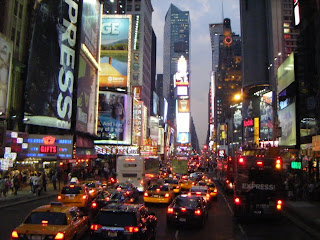 Times Square at night is kind of insane. I've heard that New Yorkers avoid it like the plague. It's so busy and so bright that it doesn't feel like night time at all. I want a taxidermist to display Dick Clarke's remains here permanently. It's not the same without him.
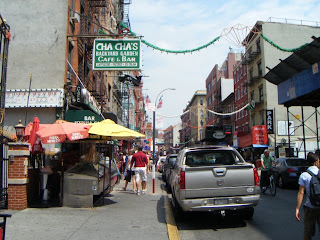 I think that my father was a bit disappointed that Little Italy is only a single street (Mulberry). Apparently it was previously larger. Chinatown, which lies immediately south, has exploded in the past few decades, and has encroached on most of Little Italy's territory.
In the brief time that I was here, I tried to experience at least a little bit of what 'The Big Apple' has to offer. For instance, I finally got to try cannoli, which are Sicilian pastries that are quite popular among Italian-American communities. Despite having grown up in an Italian household, I'd never tried them before (neither had my dad, actually). They're delicious - Fat-Carlo approves! In terms of edibles, I don't think that we were staying in the best part of Manhattan (Midtown, Clinton). None of the delis in our vicinitywere actual delicatessens - instead they sold pre-prepared Middle-Eastern food; thus my father was cheated out of the authentic salami he was expecting...
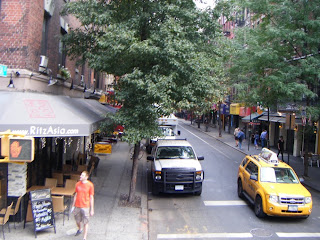 The 'villages' (Greenwich, East, and West) are very nice, and apparently, very, very, expensive. Listening to the tour drivers describe the cost of rent here made us wonder how anybody can afford to live on the island.
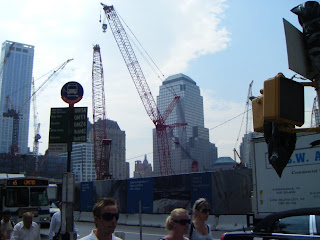 My father really wanted to take a walk down and see where the World Trade Center attacks occurred. Here's a picture and, as you can see, nine years after the fact the area still hasn't recovered. They're building a memorial tower that will be completed in 2012.
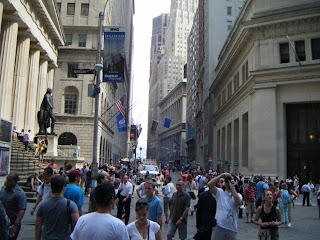 This narrow little street happens to be the very famous and very influential Wall St. Immediately to the right of where I took this photo is the New York Stock Exchange, where a bunch of folks toss around imaginary numbers and get rich, apparently.
While I doubt I could afford to live anywhere near the areas that we visited, I think that I would enjoy living in NYC. Despite my rather humble beginnings, I have become quite the 'city boy'. I think that I would appreciate the amenities that a big, bustling place like this has to offer. That being said, my one (and likely not only) problem with the place is that people seem to be rather superficial. There's a pretty hefty amount of 'fashion' running around, and anyone who knows anything about me knows that when it comes to trends, I couldn't care less1.
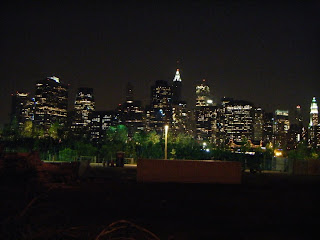 The Manhattan skyline as seen from Brooklyn at night.
 What series of photos of NYC would be complete without at least a single shot of Lady Liberty herself, as seen from the ferry heading to Liberty Island? Pro tip, it takes quite a while of waiting in line to get to the island and there isn't any opportunity to use the restroom until you get on the boat. I'd skip coffee or beverages in the morning...
Given that I visited New York with my parents, this trip was probably more 'touristy' than one I would've planned myself (I'd much rather read about the sites in a Lonely Planet and then go see them on foot, rather than booking a tour bus, for instance). Some of the 'main attractions' are rather busy, and there's more than enough to see without really ever having to stand in lines. There are quite a few areas of the city that I don't feel that I explored enough (if at all) and I'd certainly like to return here one day in the future - time and finances permitting!
1Though I feel the need to begin caring at least somewhat about fashion. Being single does have its disadvantages!
 Times Square at night is kind of insane. I've heard that New Yorkers avoid it like the plague. It's so busy and so bright that it doesn't feel like night time at all. I want a taxidermist to display Dick Clarke's remains here permanently. It's not the same without him.
 I think that my father was a bit disappointed that Little Italy is only a single street (Mulberry). Apparently it was previously larger. Chinatown, which lies immediately south, has exploded in the past few decades, and has encroached on most of Little Italy's territory.
 The 'villages' (Greenwich, East, and West) are very nice, and apparently, very, very, expensive. Listening to the tour drivers describe the cost of rent here made us wonder how anybody can afford to live on the island.
 My father really wanted to take a walk down and see where the World Trade Center attacks occurred. Here's a picture and, as you can see, nine years after the fact the area still hasn't recovered. They're building a memorial tower that will be completed in 2012.
 This narrow little street happens to be the very famous and very influential Wall St. Immediately to the right of where I took this photo is the New York Stock Exchange, where a bunch of folks toss around imaginary numbers and get rich, apparently.
While I doubt I could afford to live anywhere near the areas that we visited, I think that I would enjoy living in NYC. Despite my rather humble beginnings, I have become quite the 'city boy'. I think that I would appreciate the amenities that a big, bustling place like this has to offer. That being said, my one (and likely not only) problem with the place is that people seem to be rather superficial. There's a pretty hefty amount of 'fashion' running around, and anyone who knows anything about me knows that when it comes to trends, I couldn't care less1.
 The Manhattan skyline as seen from Brooklyn at night.
 What series of photos of NYC would be complete without at least a single shot of Lady Liberty herself, as seen from the ferry heading to Liberty Island? Pro tip, it takes quite a while of waiting in line to get to the island and there isn't any opportunity to use the restroom until you get on the boat. I'd skip coffee or beverages in the morning...
Given that I visited New York with my parents, this trip was probably more 'touristy' than one I would've planned myself (I'd much rather read about the sites in a Lonely Planet and then go see them on foot, rather than booking a tour bus, for instance). Some of the 'main attractions' are rather busy, and there's more than enough to see without really ever having to stand in lines. There are quite a few areas of the city that I don't feel that I explored enough (if at all) and I'd certainly like to return here one day in the future - time and finances permitting!
1Though I feel the need to begin caring at least somewhat about fashion. Being single does have its disadvantages!
Monday, August 9, 2010
Truly Becoming a 'Mad Biologist'...
So I'm sitting on a bus, having temporarily left the Washington, DC area to spend a few days in New York City. In front of me is the book I've been reading on this trip: a collection of Kafka's works called 'The Metamorphosis and Other Stories'. This gets me to thinking: What is the point of reading Kafka (and trust me, some effort is involved in its reading) if I'm not really going to have anyone to talk to about it?
In the past couple of months, I've had multiple people talk to me about my blog, including friends, family, colleagues, acquaintances met at scientific meetings, and even one visiting professor. Who knew that so many people were taking the time to read what I was writing here? Anyways, the majority of them have made comments about how unfortunate it is that I essentially stopped blogging (in fact I'm not sure that anyone's going to be reading this, given that I've been 'off the grid' for so long that I doubt anyone comes here anymore). Truth is, every time someone brings up the blog, it wounds me a little bit; there are lots of memories invested in this small corner of cyberspace, and my decision to cut down on blogging was not made lightly.
The past - what has it been now? - 5 months have been rather tumultuous for me. As always, my work has been taking up the lion's share of my time, and I diverted all of my efforts into working on a side-project with a highly uncertain future. If it comes together perhaps I'll be able to talk about it some day. On a more personal note, I have recently found myself a bachelor after many, many years of having been off of the 'market'. This really isn't necessarily a 'bad' thing, however; a career in the sciences is a harsh mistress and sometimes neither person is willing to sacrifice their goals in order to accommodate a relationship. It's not like I'm worried, many opportunities for such things lie ahead.
Anyways, in the tradition of past blog posts here is a map of my current journey:

I think I want to start blogging regularly again...
'Spring Breeze' website update

The 'Spring Breeze' collection by Rant has started shipping to our stockists around Australia and the new website has now gone live !
The collection has a new look as we have now divided the range into smaller stories.
Each of these stories is ready for delivery in store by a particular date. That way you know when to expect your favourite styles to be arriving in store.
Contact us on the Rant website (http://www.rantclothing.com.au/contact.html) if you would like further information as some stockists may vary these dates slightly.
We look forward to hearing from you and let us know if you have any comments or feedback too.
Enjoy your Rant garments !
Sunday, August 1, 2010
Wind Power for 'Spring Breeze' collection

Rant has recently committed to purchasing 100 % greenpower for all electricity used at our office.
This was purely a coincidence while we were designing the 'Spring Breeze' collection, and I'm sure our renewable energy providers will be hoping for more than a breeze to power their turbines !
Another example of Rant's real commitment to sustainable fashion.
If you're interested in finding out further information for yourself, click on the greenpower link in our Green links section of the Rant blog.
(image from windrevolution.com)
Subscribe to:
Posts (Atom)